Introduction
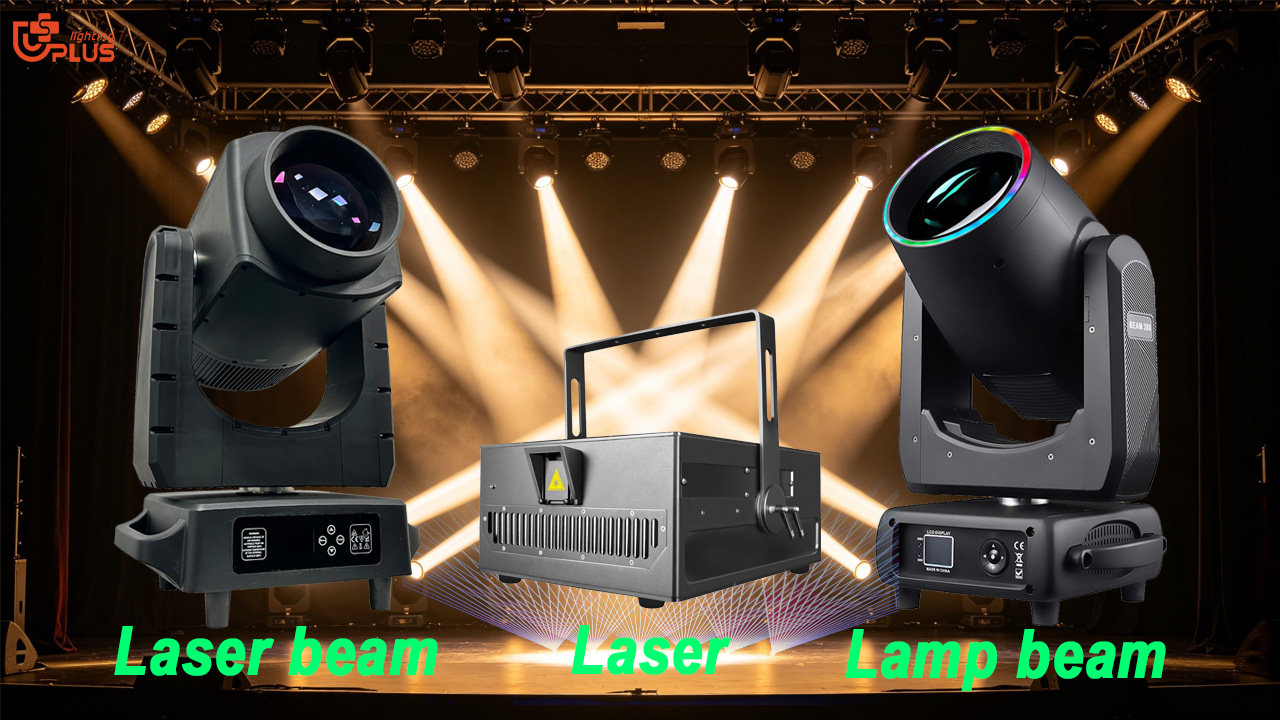
In stage lighting, event production, nightclub decoration, and commercial landscape lighting, laser light source beams and traditional lamp light source beams are the two most mainstream light output forms. Many lighting buyers, technicians, and project contractors often struggle to distinguish between them. Choosing the wrong light source beam will lead to poor stage effects, low customer satisfaction, or unnecessary cost waste.
This article will comprehensively compare laser light source beams and lamp light source beams from working principles, optical characteristics, beam performance, application scenarios, safety, and cost. It helps you clearly understand their differences and select the most suitable lighting equipment for your projects.
1. Core Working Principle Difference
1.1 Lamp Light Source Beam
A lamp light source beam comes from traditional lighting sources, including LED lamps, halogen lamps, and traditional bulb moving head lights. It generates light through spontaneous emission. Inside the lamp body, electric energy excites atoms to release photons randomly.
These photons have different wavelengths, phases, and propagation directions. After passing through lenses, diaphragms, and optical systems, the light forms a visible beam. However, the inherent random emission feature determines the basic attributes of traditional lamp beams: scattered, multi-wavelength, and incoherent.
1.2 Laser Light Source Beam
Laser is the abbreviation of Light Amplification by Stimulated Emission of Radiation. Different from lamp light sources, laser beams are produced by stimulated emission. Under precise energy excitation, atoms release photons with completely consistent frequency, phase, and direction.
All photons of a laser beam move in an orderly and unified state. This unique luminous principle is the fundamental reason why laser beams have superior concentration, purity, and stability that traditional lamp beams cannot achieve.
2. Key Optical & Performance Differences
2.1 Beam Directivity & Divergence
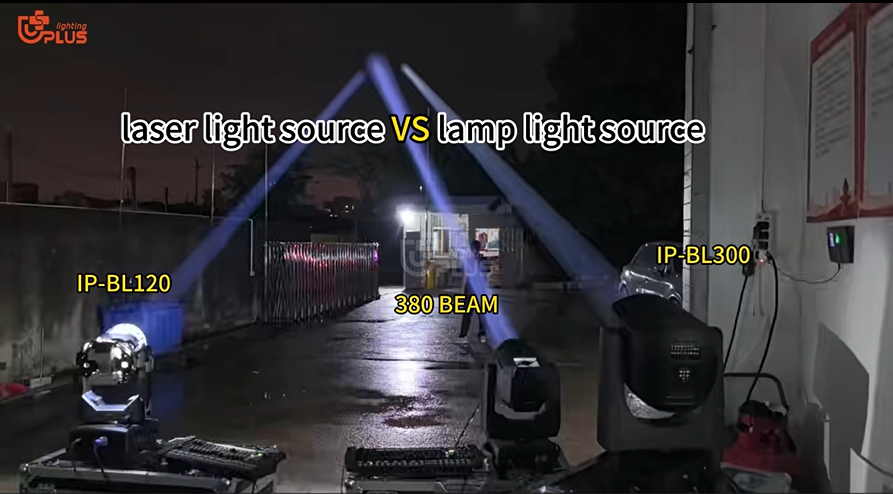
Lamp Light Source Beam: It has high beam divergence. Even after optical focusing, the light will spread rapidly during propagation. The beam becomes wider and dimmer with increasing distance. The long-distance beam boundary is blurred, and it cannot form a sharp linear light effect.
Laser Light Source Beam: It features ultra-low divergence and excellent straightness. The beam remains narrow, straight, and clear in long-distance transmission. No obvious diffusion or brightness attenuation occurs, creating ultra-sharp light lines and precise spot effects, which is irreplaceable for stage long-distance beam performances.
2.2 Color Purity & Monochromaticity
Lamp Light Source Beam: Traditional lamp light contains a continuous spectrum with multiple mixed wavelengths. Even after color filtering, the light color is impure with soft color transition, color deviation, and poor layering. The visual color saturation is relatively low.
Laser Light Source Beam: Laser has extreme monochromaticity, with a single fixed wavelength. The light color is pure, bright, and highly saturated, without color clutter. It can present gorgeous and delicate color effects for high-end stage light shows and immersive performances.
2.3 Light Energy & Brightness Stability
Lamp Light Source Beam: Light energy is dispersed evenly. The overall brightness is uniform, suitable for large-area lighting. But the unit area energy is low, with no concentrated light spot. The brightness decays obviously with distance, and the long-term working stability is average.
Laser Light Source Beam: Light energy is highly concentrated in a narrow beam range. It can maintain ultra-high local brightness in long-distance propagation with almost no brightness loss. The light output is stable and flicker-free, perfectly matching high-speed shooting and dynamic stage rhythm effects.
2.4 Light Coherence
Lamp Light Source Beam: Incoherent light. The light waves are disordered and cannot produce interference, diffraction, and other special optical effects, so the light effect is single and conventional.
Laser Light Source Beam: Highly coherent light waves. It can form unique optical effects such as light curtain diffraction, beam stacking, and 3D light modeling, greatly enriching stage visual layers.
3. Application Scenario Differences
3.1 Lamp Light Source Beam Applications
Traditional lamp beams focus on practical lighting and basic atmosphere rendering, suitable for most conventional lighting scenarios:
-
Stage main lighting, actor fill light, and background basic lighting
-
Wedding halls, banquet halls, and conference room fixed lighting
-
Live streaming studios, short video shooting fill light
-
Outdoor landscape lighting, building floodlight lighting
-
Small and medium-sized bars, KTV basic atmosphere lighting
3.2 Laser Light Source Beam Applications
Laser beams focus on special effect rendering and high-end immersive visual experience, mainly used for high-demand performance scenarios:
-
Concert large-scale dynamic beam light shows
-
Nightclub, bar dynamic rhythm laser effects
-
Scenic spot night tour immersive light and shadow shows
-
3D holographic light projection and space light modeling
-
Large-scale festival performances and customized art light shows
4. Pros and Cons Comparison
4.1 Lamp Light Source Beam
Advantages: Soft and uniform light, high safety, no radiation damage, wide lighting coverage, low cost, simple operation and maintenance, rich color matching, suitable for long-time continuous work.
Disadvantages: Poor beam straightness, impure color, serious long-distance light attenuation, single special effect, unable to present ultra-fine beam lines.
4.2 Laser Light Source Beam
Advantages: Ultra-sharp beam, pure color, stable long-distance brightness, strong visual impact, diverse dynamic special effects, support 3D space light modeling.
Disadvantages: High equipment cost, strict safety operation standards, concentrated energy with potential eye damage risk, not suitable for large-area basic lighting.
5. Safety & Service Life Differences
Lamp Light Beam: Extremely high safety. Long-term irradiation will not cause damage to human eyes and skin. The service life of LED lamp sources can reach 50,000+ hours, with low failure rate and simple daily maintenance.
Laser Light Beam: High energy concentration brings certain safety risks. Direct long-term eye contact will cause visual damage. Professional operation and standardized installation are required. Qualified laser lights have stable service life, but the maintenance threshold is higher than traditional lamp lights.
FAQ (Frequently Asked Questions)
Q1: Which is better for stage lighting, laser beam or lamp beam?
There is no absolute better one. They are complementary. Lamp beams are used for main lighting, fill light and large-area atmosphere rendering, while laser beams are used for dynamic special effects and high-impact beam performances. Most professional stages adopt a combination of both.
Q2: Are laser light beams brighter than traditional lamp beams?
Laser beams have higher local concentrated brightness with no long-distance attenuation. Traditional lamp beams have uniform overall brightness but poor long-distance effect. For long-distance beam display, laser beams are far superior; for short-distance full-site lighting, lamp beams perform better.
Q3: Are laser stage lights safe for public venues?
Certified low-power laser stage lights are safe for public venues when operated correctly. It is forbidden to use unqualified high-power laser equipment, and avoid direct laser irradiation on crowds and eyes.
Q4: Can laser beams replace traditional lamp beams?
No. Laser beams cannot achieve soft and uniform large-area lighting, so they cannot replace lamp light source beams for basic venue lighting. The two types of light sources can only cooperate with each other to achieve the best stage effect.
Q5: Which one is more cost-effective for small event lighting?
Traditional lamp light source beams are more cost-effective for small weddings, small parties and daily event lighting. Laser lights are more suitable for high-end customized performances and commercial entertainment venues with high effect requirements.
Conclusion
The essential difference between laser light source beams and lamp light source beams lies in the luminous principle and optical characteristics. Lamp beams focus on uniform, safe and universal basic lighting, while laser beams focus on high-precision, high-purity and high-impact special light effects.
For lighting practitioners, understanding these differences can help you match accurate lighting solutions for different projects, improve stage presentation effects, and avoid equipment selection errors. Reasonable collocation of laser lights and traditional lamp lights is the best choice for modern professional stage lighting.









 Scan QR Code
Facebook
Instagram
YouTube
VK