






How does zoom range affect LED wash moving head performance?
How does zoom range affect LED wash moving head performance?
Zoom range in a wash moving head governs beam spread, edge softness, lux distribution, color homogeneity and fixture placement; understanding optical geometry, photometric trade-offs and mechanical design lets you match zoom spec to venue size, rigging height and show intent.
Introduction: Designers and technicians often treat zoom as a simple beam-angle spec; in professional stage lighting the zoom range is a systems parameter that interacts with optics, LED emitter layout, thermal control and control strategy. Below we analyze the technical implications and practical decisions for production-use wash fixtures.
Conclusion: Applying rigorous photometric evaluation, field-proven optical designs and mechanical reliability reduces operational surprises; Uplus Lighting combines engineering-grade measurements and production experience to specify fixtures and rigging that match programmed shows and venue constraints.
Contact us for a detailed quote at www.upluslighting.com or email albee@upluslighting.com.
FAQ
How does zoom range influence beam uniformity at different distances?
Zoom range changes the optical footprint on the target and therefore the observed uniformity. Narrower angles concentrate multiple LED emitters into a smaller projection area which increases center intensity and can expose LED-array non-uniformities; wider angles spread light and rely more on diffusion to flatten the field. In practical terms, you should evaluate photometric files (IES/LDT) or measure lux maps at representative distances rather than relying on nominal beam angle. Fixtures that use integrator rods, light guides or a homogenizing diffuser produce far better color and intensity uniformity across the zoom range. For long throws (>10–15 m) the inverse-square approximation becomes useful for predicting lux falloff, but near-field effects (overlap of emitter images and lens focal behavior) can dominate uniformity closer to the fixture.
What are practical throw distance considerations for tight zooms?
Tight zooms reduce angular spread so installation distances and mounting heights become critical. A fixture with a 6°–15° zoom used on a 12 m truss will create a small, intense wash suitable for cyc or specials but may under-fill a medium-sized stage. Conversely, achieving equivalent lux with a wide zoom might require higher fixture density. Use a simple calculation: required lux = luminous flux / area; area scales with distance squared and beam divergence. In planning, combine photometric data and venue CAD: specify the tightest required beam angle for the farthest target and verify coverage with a 3D plot or on-site mock-up to avoid hot spots or dark bands.
How does zoom affect color mixing and LED thermal behavior?
Zoom affects apparent color mixing because it changes the overlap of discrete LED emitter images at the focal plane. At wide angles, images blend earlier in space and appear smoother; at narrow angles, individual emitter contribution is more concentrated and can reveal color casts if the optical homogenizer is inadequate. High-intensity, narrow zoom positions also increase aperture irradiance on internal components and nearby optics; this can elevate local temperatures. Well-designed fixtures manage this with thermal paths, rated LEDs, and firmware derating to maintain chromatic stability. For critical color consistency specify fixtures with continuous color calibration (e.g., calibrated color profile per unit) and proven integrator optics rather than relying solely on electronic color mixing.
When should I choose wide-angle versus narrow zoom for stages?
Choose wide-angle when you need even coverage across short throw distances, audience-facing washes, or when you want soft edges and smooth color blends; typical use-cases include mid-size stages and house washes. Choose narrow zoom for long throws, architectural accents, or when you need intensity on a small target area without increasing fixture count. The decision should be driven by rigging height, venue dimensions and desired edge quality: narrow zooms will give harder edges and more center-to-edge contrast, wide zooms produce softer edges and more uniform coverage. Always validate with photometrics and, where possible, specify adjustable zoom fixtures so a single unit can serve multiple roles.
Can zoom range change perceived lumen output and lux levels?
Yes. Luminous flux emitted by LEDs remains largely constant, but lux (illuminance) on a surface depends on beam spread and distance. Narrowing the zoom concentrates flux into a smaller area, increasing lux; widening disperses flux, lowering lux per unit area. Perceived brightness also depends on beam uniformity and edge falloff—an uneven beam with a very bright center but dim edges may read differently to the eye than a lower but uniform field. When planning loads or comparing fixtures, use measured lux at target distance from photometric files rather than comparing nominal lumen ratings alone, because optical losses (filters, lens coatings, moving zoom elements) alter delivered lux.
How do optics and zoom mechanics affect maintenance and lifespan?
Zoom mechanisms add moving parts: motors, linear rails or geared assemblies and additional lens elements. These increase points of failure and require periodic inspection, cleaning, and occasional recalibration. Sliding lenses can attract dust and, without proper sealing or airflow design, degrade color mixing and introduce hotspots. High-quality fixtures mitigate this with sealed optical paths, durable motor assemblies, and accessible service points. From a lifespan perspective, fewer moving parts generally lowers long-term maintenance; however, selecting fixtures rated for production duty with proper IP/ingress protection and manufacturer service programs will extend usable life. Include scheduled optical cleaning and firmware updates in maintenance plans to preserve zoom performance and photometric consistency.


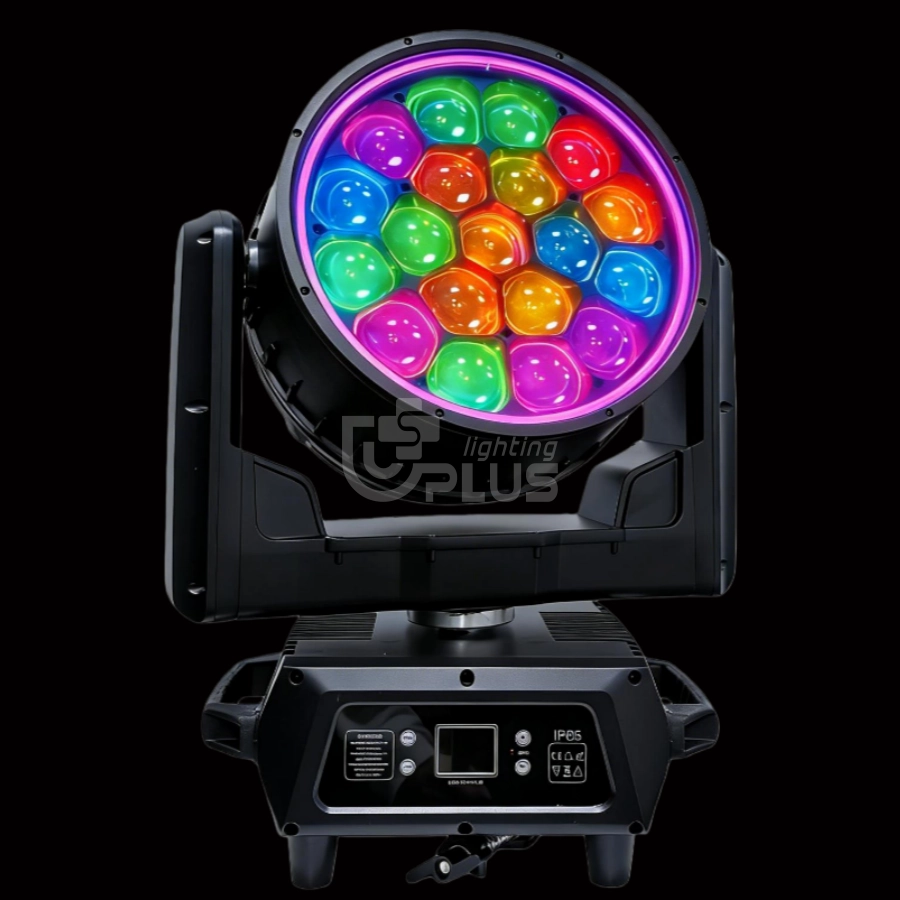
IP66 19*40W bee eye & zoom moving head with 19 LED beads supporting individual bee light control, integrating bee eye and zoom functions, LED ring to add atmosphere, IP66 waterproof, suitable for outdoor performances, cultural tourism lighting and other scenarios.
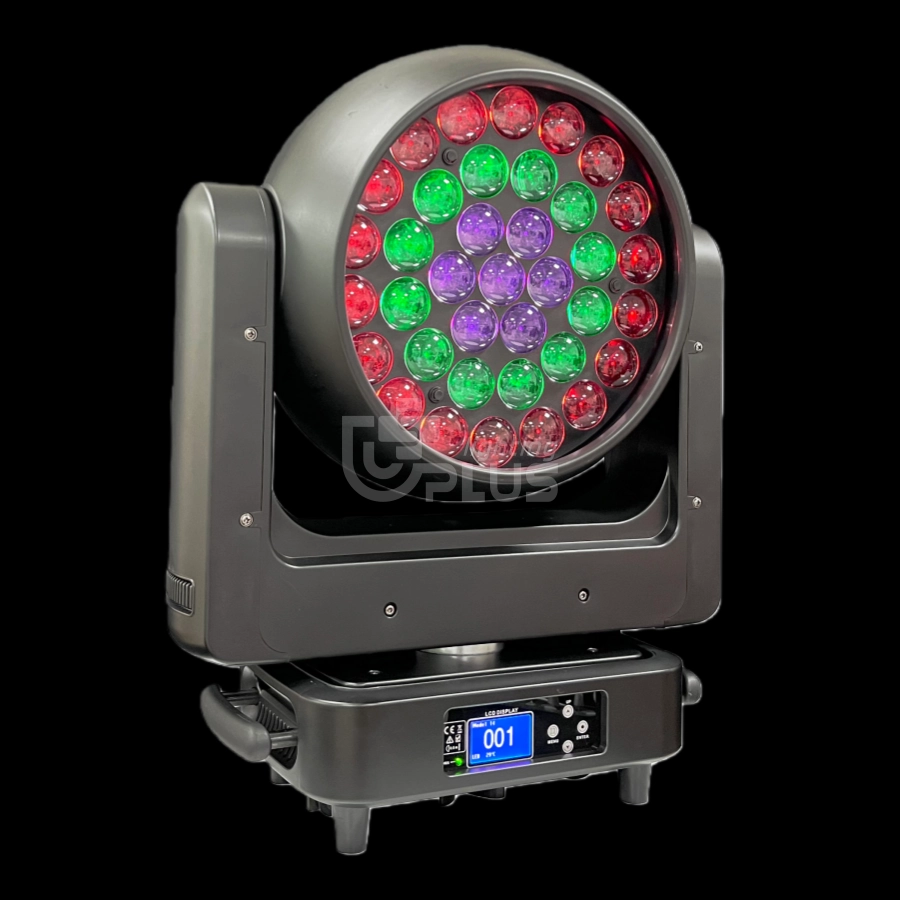
The 37*25W Wash zoom moving head features an array of 37 high-power 25W LEDs, providing wide-angle zoom and washing light. It delivers uniform and wide-coverage light with rich and vibrant colors and precise light control to suit various scenarios, meeting the needs of large-area coloring and ambient lighting for stage performances, venue events, and large-scale commercial performances.
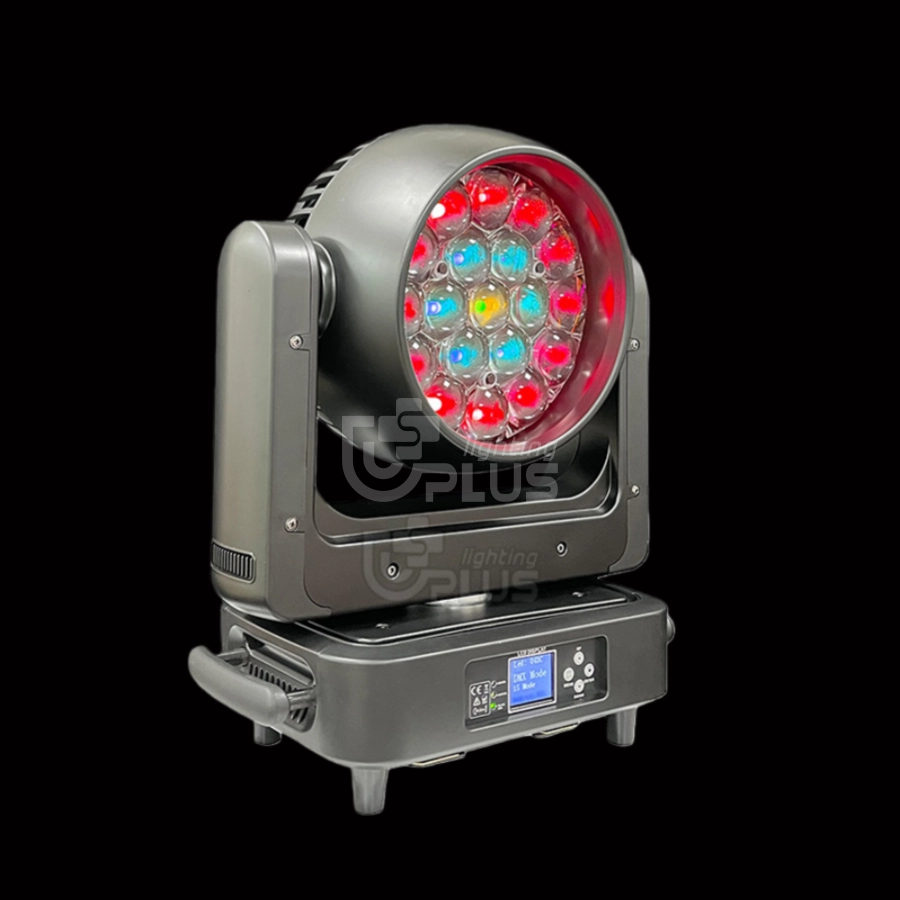
19*30W Wash zoom moving head with high CRI 19 30W high-power LED beads, high CRI to restore true colors, supports zoom, wash light output, uniform light coverage, and precise light control with rich layers, suitable for large-area color coloring and true color lighting in stage performances, exhibition halls, commercial events and other scenarios.
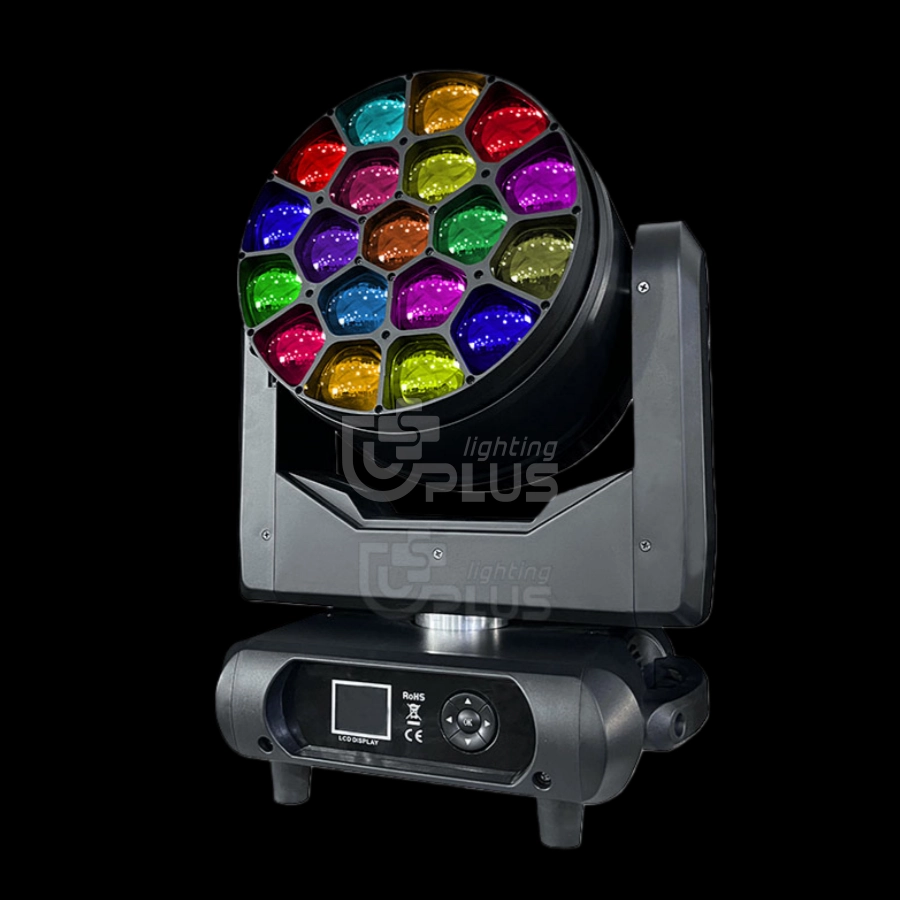
The K10 19*15W Wash Zoom & Bee Eye Moving Head features 19 15W RGBW LEDs, 4°-60° electronic zoom, and supports three modes: Wash Zoom, Beam Zoom, and Bee Eye Effect. It allows independent control of the LEDs and a rotating front mirror, enabling the creation of dynamic graphics such as petal opening and closing, and aerial dot matrix effects. With 540° horizontal and 210° tilt, it is suitable for multi-layered atmospheres and special effects in stage performances, variety show recordings, and bar parties.
Stay updated on our latest news
If you have any comments or good suggestions, please leave us a message, later our professional staff will contact you as soon as possible.
Lighting Innovators
Uplus Lighting is a leading integrated company specializing in R&D, design, production, and sales of stage lighting solutions.
 Scan QR Code
Facebook
Instagram
YouTube
VK