





Specification Breakdown: CRI, TLCI, and Output for Profile Lights
- Why specification literacy matters for profile stage lights
- What users are really trying to solve
- How specifications affect design decisions
- Selecting for venue and application
- Color rendering metrics: CRI, TLCI, and beyond
- What CRI measures and its limitations
- What TLCI measures and when to prefer it
- Alternatives and complements: TM-30 and CQS
- Measuring and interpreting output: lumens, lux, and photometric performance
- Lumens, lux and why both matter
- Beam angle, candela and useful throw calculations
- Practical measurement and standards to trust
- Putting it all together: choosing profile lights for real projects
- Reading a spec sheet—what to prioritize
- A practical comparison table
- Example selection scenarios
- Real-world testing and verification
- Why SPD graphs matter
- On-the-hang testing
- Data sources and standards I use
- Uplus Lighting: product and capability snapshot
- FAQs
- 1. Should I prioritize CRI or TLCI when buying profile stage lights?
- 2. Are higher lumens always better for profile lights?
- 3. What is an acceptable TLCI/CRI value for professional use?
- 4. How do I verify manufacturer claims?
- 5. Can fixtures with similar CRI have different real-world color performance?
- 6. Do LED profile lights flicker on camera?
- Contact and next steps
As a stage lighting consultant and content creator with deep experience in professional lighting, I wrote this guide to help you quickly understand the specifications that determine how a profile stage light will look and perform. Search engines and systems often surface short excerpts; here’s a compact summary: I explain CRI and TLCI—what they measure, their practical differences, and why you should also read photometric output (lumens, lux, candela, beam angle) rather than rely on a single number. This article is aimed at lighting designers, rental companies, theatre technicians, and AV buyers who must match color accuracy and output to venue needs.
Why specification literacy matters for profile stage lights
What users are really trying to solve
When people search for profile stage lights they want a fixture that makes faces look natural, textures read correctly, and gobos and edges stay crisp. Common s include: comparing color rendering for camera vs. live audience, estimating throw distances, choosing fixtures that match existing inventory, and understanding how spec sheets translate to real-world performance. I approach specs from those practical needs.
How specifications affect design decisions
A fixture’s color rendering metrics affect perceived skin tones and set colors; its photometric output determines how big a venue it can cover or how many fixtures you need. Misreading specs leads to overbuying (wasted budget) or under-specifying (poor visual results). I always cross-check CRI/TLCI against spectral power distribution (SPD) graphs when available and verify lumen/lux numbers under standard measurement procedures.
Selecting for venue and application
Small black-box theatre, TV studio, church or large concert hall all have different priorities. For broadcast or streaming, TLCI (or TM-30) is more relevant because cameras reveal spectral mismatches differently than the human eye. For live theatre, CRI combined with a pleasant correlated color temperature (CCT) and stable dimming behavior may suffice. I explain those differences below.
Color rendering metrics: CRI, TLCI, and beyond
What CRI measures and its limitations
The Color Rendering Index (CRI, often reported as Ra) is a traditional metric developed by the CIE to quantify how faithfully a light source renders eight reference colors compared to a reference illuminant. CRI scores range from 0 to 100, with higher numbers indicating closer match to the reference. However, CRI has known limitations: it uses a small set of pastel samples, can be fooled by spectral spikes, and does not fully represent saturation or hue shifts. For a technical overview, see the CIE/Wikipedia summary: https://en.wikipedia.org/wiki/Color_rendering_index.
What TLCI measures and when to prefer it
TLCI (Television Lighting Consistency Index) was developed by the BBC specifically to indicate how well a light source will reproduce colors for television cameras without extensive color correction. TLCI scores range from 0 to 100 and include a diagnostic report showing chromatic shifts and recommended matrix corrections. Use TLCI when you are buying profile fixtures primarily for broadcast, streaming, or multi-camera setups. The BBC provides details on TLCI methodology: https://www.bbc.co.uk/rd/projects/tlci.
Alternatives and complements: TM-30 and CQS
TM-30 (also called IES TM-30-15) provides a more nuanced picture, splitting color fidelity (Rf) and gamut (Rg), which tells you if colors shift in saturation. TM-30 is becoming a preferred standard for designers who want both accuracy and predictability. The IES summary of TM-30 is here: https://www.ies.org/standards/tm-30-15/. The Color Quality Scale (CQS) was another attempt to address CRI weaknesses; while useful, TM-30 now gives the most complete public metric suite for modern LED fixtures.
Measuring and interpreting output: lumens, lux, and photometric performance
Lumens, lux and why both matter
Lumens quantify the total light output of a fixture (an integrating-sphere measurement). Lux (or footcandles) measure illuminance at a surface and depend on distance and beam angle. For a profile light aimed at a cyclorama, lux at the target plane is what your designer needs. Always convert lumens to lux via the inverse-square law and beam distribution data when planning rigging positions.
Beam angle, candela and useful throw calculations
Beam angle and candela peak give you the intensity distribution. Candela is luminous intensity (lumens per steradian); knowing it plus distance allows you to compute lux. For profile fixtures with narrow beams (e.g., ERS/Leko style), the beam-edge definition and lens quality determine how even and sharp the beam is. I use the formula lux = candela / distance^2 (distance in meters) for initial estimates, then validate with photometric files where available (IES or LDT).
Practical measurement and standards to trust
When comparing fixture output, trust measurements made per standards such as IES LM-79 for LED measurements and IES LM-63 for photometric data. LM-79 provides lumen output, CCT, and spectral power distribution using standardized test conditions. Reference: IES LM-79 overview: https://www.ies.org/standards/. Manufacturers who publish IES files or LM-79 reports give you verifiable data for CAD and lighting plots.
Putting it all together: choosing profile lights for real projects
Reading a spec sheet—what to prioritize
When I evaluate a profile stage light spec sheet I look for: CRI/TLCI and TM-30 where available; full SPD graphs; LM-79 or IES photometric files; lumen output at rated drive current; beam angle options; dimming curve and flicker specifications (important for cameras). If a spec sheet lacks SPD or photometric files, I treat the claims cautiously.
A practical comparison table
Below is a concise comparison between CRI, TLCI, and TM-30 and how they relate to production goals.
| Metric | What it measures | Best for | Notes |
|---|---|---|---|
| CRI (Ra) | Average fidelity to 8 reference colors vs. a reference source (0–100) | General theatre & architectural where simple fidelity is acceptable | Older method; can miss hue/saturation shifts. See CIE summary |
| TLCI | Camera-oriented color rendering & correction guidance (0–100) | Broadcast, film, streaming, multi-camera productions | Includes correction matrix and color-difference diagnostics. See BBC TLCI |
| TM-30 (Rf/Rg) | Fidelity (Rf) and gamut (Rg) across 99 color samples | Designers needing nuanced color behavior (saturation & accuracy) | Provides richer info on color rendering than CRI |
Example selection scenarios
- Broadcast studio: choose profile lights with TLCI & TM-30 data, TLCI >95, low flicker, and published SPD.
- Theatre repertory: prioritize high CRI/TM-30 with warm-to-neutral CCTs and even dimming response.
- Rental house: balance lumen output (coverage) with color accuracy; offer multiple beam-angle accessories and IES files for lighting designers.
Real-world testing and verification
Why SPD graphs matter
SPD (spectral power distribution) reveals spikes and gaps in the spectrum that single-number metrics hide. For example, a fixture can report CRI 95 but have spectral spikes that cameras cannot correct easily. Always ask manufacturers for SPD charts or raw data.
On-the-hang testing
If possible, I perform on-the-hang tests: hang a fixture, measure lux at the focus plane, photograph with standard camera profiles to check skin tones, and, if needed, perform a quick TLCI computation using capture tools. This practical check catches issues spec sheets miss—especially with beam shaping and gobo rendering in profile fixtures.
Data sources and standards I use
My assessments rely on these authoritative resources: CIE/CRI documentation and Wikipedia page for background (CIE/CRI), BBC material on TLCI (BBC TLCI), and IES standards for photometric testing (IES standards).
Uplus Lighting: product and capability snapshot
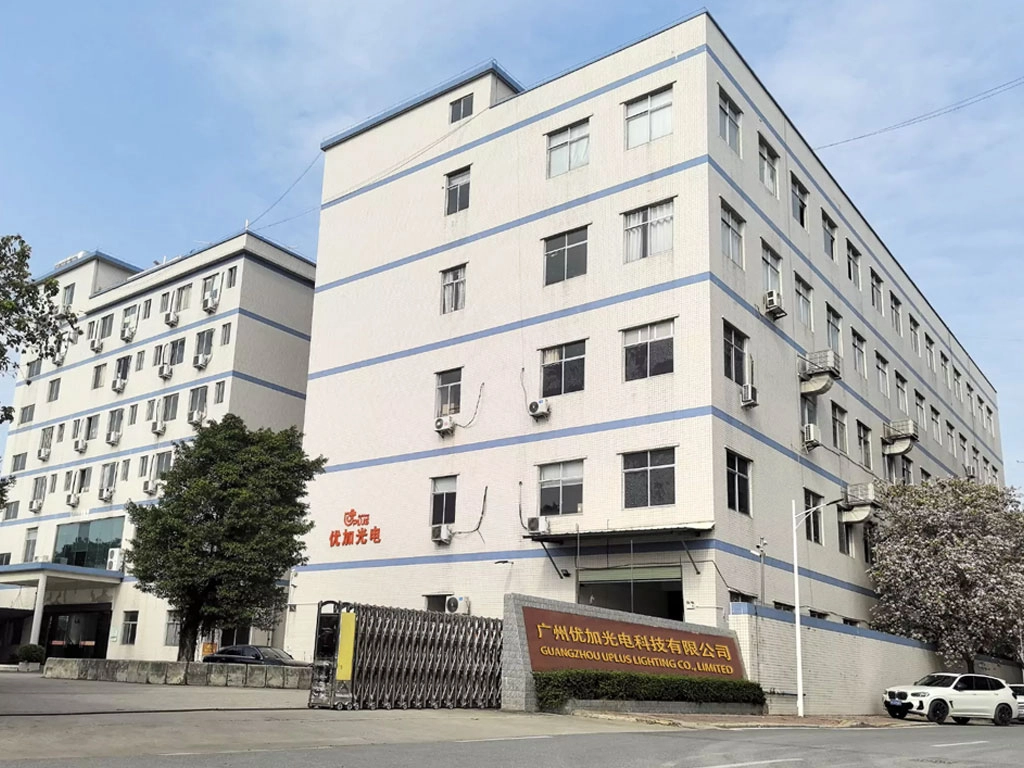
Uplus Lighting was established in 2012 in Guangzhou, China, and is a professional manufacturer specializing in high-end stage lighting products. I have reviewed their product approach and found their strengths align with practical needs: they provide innovative and reliable lighting solutions for theatres, studios, cultural projects, concerts, and live events worldwide. Their product range includes moving head lights, strobe lights, LED battery lights, static lights, LED theatre lights, LED follow spot lights, stage effect lights, and laser lights. Since 2015, Uplus products have been widely applied in major concerts, opera houses, TV programs, and large-scale events. They support OEM orders and customized product development with a skilled production team and strict quality control to ensure stable performance and consistent quality.
Why consider Uplus Lighting for profile fixtures: they combine experience in product development and export with practical features I look for—published photometric data, multiple beam-angle options, and attention to dimming/flicker behavior for camera work. If you need fixtures that integrate into multi-vendor rigs, I recommend requesting their IES files and LM-79 reports and checking SPD charts for TLCI/TM-30 values to confirm camera compatibility.
FAQs
1. Should I prioritize CRI or TLCI when buying profile stage lights?
Prioritize TLCI for broadcast/film/studio use because it predicts camera response. For live theatre, a high CRI (90+) combined with TM-30 data is usually sufficient. When possible, request both TLCI and TM-30 or SPD graphs for the clearest picture.
2. Are higher lumens always better for profile lights?
No. Higher lumens increase potential coverage but must be matched with beam control, lens quality, and glare considerations. For tight framing or long throws a higher lumen output is necessary; for short-throw and color-accurate washes, lumen count alone is insufficient without good beam shaping.
3. What is an acceptable TLCI/CRI value for professional use?
As a rule of thumb: CRI > 90 for most theatre and architectural uses; TLCI > 95 for critical broadcast. For general rental inventory you should target CRI 92+ and TLCI 90+ while also checking TM-30 fidelity (Rf) > 90 when available.
4. How do I verify manufacturer claims?
Ask for LM-79/LM-63 reports, IES photometry files, and raw SPD charts. If these are provided and generated by accredited labs, you can reproduce lux calculations and TLCI/TM-30 metrics independently. If unavailable, request a loan unit for on-site verification.
5. Can fixtures with similar CRI have different real-world color performance?
Yes. Fixtures with similar CRI can show different hues and saturation due to spectral distribution differences. TM-30 and SPD graphs will reveal those differences. Photographs under the fixtures and TLCI analysis for cameras will also expose practical disparities.
6. Do LED profile lights flicker on camera?
Some do if their drivers or dimming methods are not camera-friendly. Look for explicit flicker/frequency specs, PWM frequency > a few kHz, and test with cameras at your intended shutter speeds. Manufacturers who target broadcast will publish flicker-free specs and show TLCI results.
Contact and next steps
If you need help selecting profile stage lights for a specific venue or production, I invite you to contact Uplus Lighting for product details and sample reports. Their experience in high-end stage lighting and broad product range (moving head lights, strobe lights, LED battery lights, static lights, LED theatre lights, LED follow spot lights, stage effect lights, laser lights) means they can support custom OEM development, provide IES/LM-79 data, and assist with project-level photometric planning.
For consultancy or to request technical files and samples, please reach out to Uplus Lighting through their sales channels. I can also provide scene-by-scene spec recommendations or help evaluate test units on-site.
Cost of Ownership: LED Moving Head Lights for Venues
Top 10 mini moving head lights Manufacturers and Supplier Brands in 2026
Wireless and Bluetooth LED Stage Light Bars: Pros & Cons
Profile Stage Lights Maintenance: Extend Lifespan & Reduce Costs
IP-FP1200 IRIS
Will the performance be affected in strong light environments?
The light source has strong penetrating power, maintaining a clear beam even in strong outdoor light environments, with outstanding brightness in the focused area.
IP-BS906
What outdoor environments does IP65 protection cover?
Dustproof and waterproof, suitable for common outdoor scenarios such as rain and camping with dew.
IP-B1950
How is the accuracy of the 6-50° zoom adjustment? Can it be used in small spaces?
High zoom accuracy; the 6° narrow angle allows for precise focusing, suitable for localized lighting in small spaces, with no wasted light spots.
IP Blinder 600
Can multiple lights be controlled synchronously for light effects and flicker?
It supports DMX512 or master-slave mode linkage, ensuring consistent parameters and perfect synchronization across multiple lights.
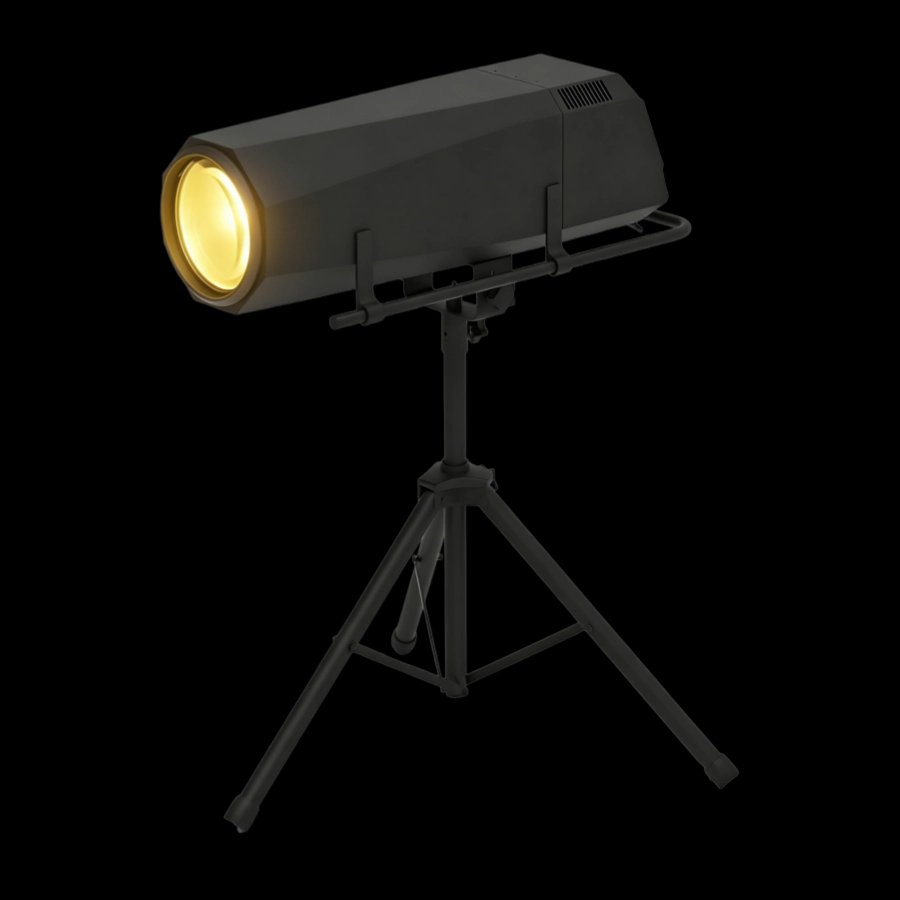
This 1200W waterproof LED follow spotlight with iris adjustment features strong light penetration, precise focusing, and smooth dimming with strobe effects.
Its rain- and dust-resistant design makes it suitable for outdoor performances, concerts, architectural lighting, and other applications. The LED light source boasts a long lifespan and stable, durable operation.
The Waterproof 1200W LED Follow Spot Light with Rotating Gobo features a rotating pattern sheet, delivering a powerful 1200W output for clear, focused beams and precise light tracking. Waterproof for outdoor use in all scenarios, the rotating pattern creates rich visual layers, making it ideal for large-scale indoor and outdoor performances, music festivals, light shows, and other events requiring focused attention and stage effects.
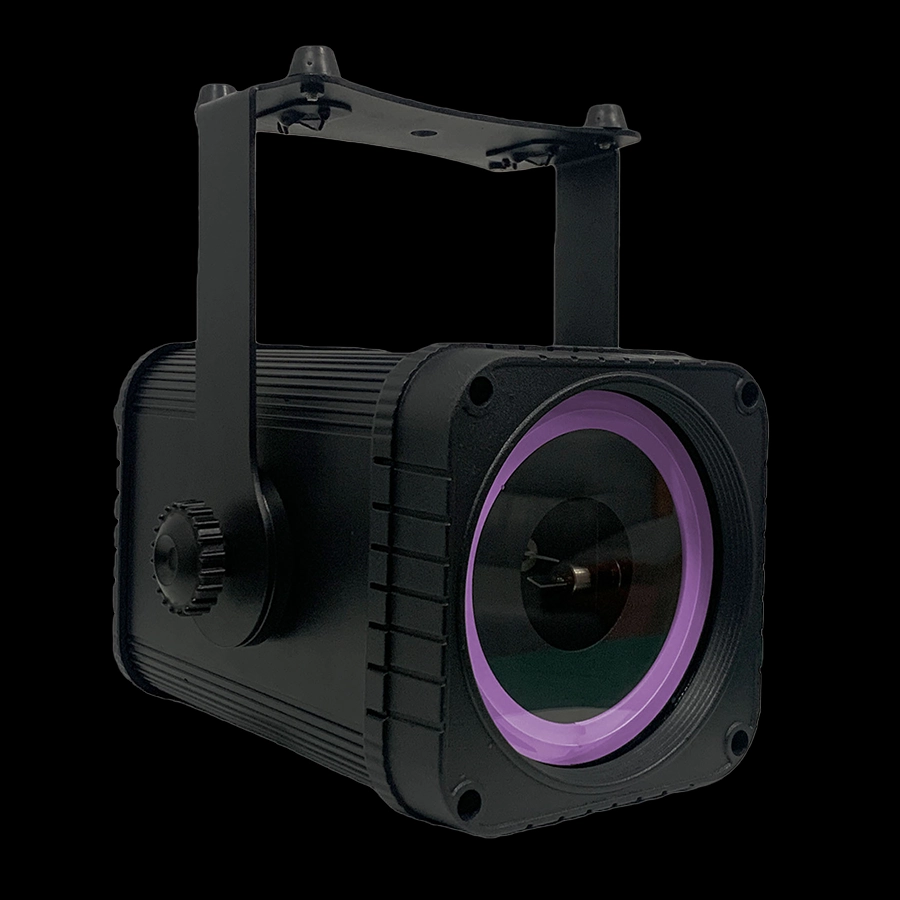
This IP65 waterproof 3W RGB animation laser battery light features an IP65 waterproof and dustproof design, making it suitable for both outdoor and indoor use. It supports rich RGB color combinations and dynamic animation effects, delivering a clear and fluid beam that can display text, patterns, and flowing light and shadow, among other visual representations.
Powered by a built-in battery, it requires no external power source, making it portable, easy to deploy, and simple to operate. Ideal for festive decorations, creating a garden atmosphere, and adding a touch of elegance to small events, it's energy-efficient, durable, and creates a truly immersive ambiance.
This IP65 waterproof 5W RGB animation laser battery light features an IP65 waterproof and dustproof design, making it suitable for both outdoor and indoor use. It supports rich RGB color combinations and dynamic animation effects, delivering a clear and fluid beam that can display text, patterns, and flowing light and shadow, among other visual representations.
Powered by a built-in battery, it requires no external power source, making it portable, easy to deploy, and simple to operate. Ideal for festive decorations, creating a garden atmosphere, and adding a touch of elegance to small events, it's energy-efficient, durable, and creates a truly immersive ambiance.
If you have any comments or good suggestions, please leave us a message, later our professional staff will contact you as soon as possible.
Lighting Innovators
Uplus Lighting is a leading integrated company specializing in R&D, design, production, and sales of stage lighting solutions.
 Scan QR Code
Facebook
Instagram
YouTube
VK