



LED vs Halogen Profile Stage Lights: Performance & Cost
- Understanding profile fixtures and their common uses
- What are profile stage lights (ERS) and why they matter
- Typical applications and user expectations
- Why the LED vs halogen question persists
- Optical and photometric performance
- Beam quality, edge definition and projection
- Color rendering: CRI, TM-30 and real-world skin tones
- Dimming, flicker and broadcast safety
- Total cost of ownership and operational considerations
- Key variables in lifecycle cost
- Representative comparative data
- Example cost calculation (illustrative)
- Making the right choice: when to pick LED or halogen
- When halogen is still the right tool
- When LED profile fixtures are superior
- Hybrid approaches and migration strategies
- Uplus Lighting: capabilities and where they fit
- Practical checklist for specification and procurement
- Technical checklist I use when specifying profile stage lights
- Questions to ask manufacturers
- FAQs
- 1. Are LED profile stage lights always better than halogen?
- 2. Do LED profiles produce the same beam quality and gobo projection as halogen ERS?
- 3. How much can I save on energy by switching to LED profiles?
- 4. Are LED profiles suitable for broadcast and high-speed camera work?
- 5. What maintenance differences should I plan for?
- 6. How should I phase upgrades from halogen to LED?
I have spent years specifying and testing profile stage lights in theatres, TV studios and concert tours. In this article I summarize how LED and halogen profile fixtures compare for real-world production needs — including beam quality, color rendering, dimming behavior, lifetime, maintenance and total cost of ownership. I ground conclusions on measured photometric properties, manufacturer data and industry standards so you can make a verifiable, practical decision for your venue or rental inventory.
Understanding profile fixtures and their common uses
What are profile stage lights (ERS) and why they matter
Profile stage lights — often called ellipsoidal reflector spotlights (ERS) — are precision fixtures used to shape light with shutters, lenses and gobos for crisp edge definition, long throw performance and controlled beam falloff. Wikipedia offers a solid technical overview of ERS design and use (Wikipedia: Ellipsoidal reflector spotlight). I refer to these fixtures as profile stage lights throughout, since that aligns with common and buying language.
Typical applications and user expectations
Clients expect profile stage lights to deliver: a sharp beam with definable edges; accurate and consistent color (for skin tones, set colors and scenic highlights); repeatable gobos and framing; and stable dimming and flicker-free output for broadcast. Rental houses also require durability, simple serviceability and predictable running costs.
Why the LED vs halogen question persists
Traditional halogen/ tungsten-based profiles historically dominated because of their color quality and simple dimming characteristics. LEDs offer efficiency and long life, but early LED profiles had issues with color rendering, hot spots or poor mixing. Today both technologies coexist; the right choice often depends on the production requirements and operational budget.
Optical and photometric performance
Beam quality, edge definition and projection
Halogen profiles excel at even beam fill and smooth edge transitions because the point-like filament combined with an ellipsoidal reflector produces predictable beam geometry. Many LED profile fixtures use multi-emitter arrays with optics that attempt to mimic that behavior. Some high-end LED profiles achieve very good edge definition, but I always measure for hot spots and edge uniformity during evaluations.
Color rendering: CRI, TM-30 and real-world skin tones
Color rendering is often the deciding factor. Halogen (tungsten) has a continuous spectrum and scores very high on CRI for skin tones. LEDs are characterized by spectral power distributions that can vary between manufacturers. While CRI (Ra) is useful, TM-30 provides a more nuanced assessment. The Illuminating Engineering Society (IES) and technical literature recommend TM-30 metrics for critical color work; see IES and background on color metrics (Wikipedia: Color rendering index). In my testing, modern LED profiles with well-designed phosphor mixes or multi-channel emitters can match or closely approach halogen performance, particularly when TM-30 Rf and Rg are optimized.
Dimming, flicker and broadcast safety
Halogen dims linearly with voltage reduction and is inherently flicker-free for most broadcast uses. LED fixtures depend on electronic drivers; quality drivers provide smooth, flicker-free dimming across the curve and support high-frequency PWM or analogue dimming profiles. For broadcast and high-speed camera work, always verify flicker performance and driver specifications — manufacturer test reports or an oscilloscope check can confirm suitability.
Total cost of ownership and operational considerations
Key variables in lifecycle cost
Total cost of ownership (TCO) includes initial purchase price, energy consumption, lamp/module replacement, maintenance labor, and disposal costs. I prefer calculating TCO over at least a 5-10 year window because LEDs have high upfront cost but much lower operating expenses and fewer service calls.
Representative comparative data
Below is a concise table comparing typical halogen (e.g., 750–1500 W tungsten) profile fixtures against modern LED profile fixtures. Figures are representative — always confirm with specific fixture photometric reports from manufacturers.
| Category | Halogen Profile (750–1500 W) | LED Profile (high-end, 200–600 W equivalent) |
|---|---|---|
| Luminous efficacy | ~15–25 lm/W (lamp+optics) | ~60–120 lm/W (fixture level) |
| Lumen output (typical spot) | 20,000–40,000 lm | 8,000–25,000 lm (depends on class) |
| Rated lifetime | 1,000–2,000 hours (lamp) | 30,000–50,000+ hours (LED module) |
| Initial cost (fixture) | Lower (older inventory) to mid-range | Higher (20–100% High Quality depending on features) |
| Operating energy | High (requires heavy dimming infrastructure) | Low (significant savings) |
| Color rendering | Excellent (continuous spectrum) | Very good to excellent (depends on LED tuning and TM-30) |
| Dimming & broadcast | Linear, broadcast-safe | Broadcast-safe if specified (check flicker tests) |
| Maintenance | Frequent lamp replacement and alignment | Minimal lamp replacement; occasional driver/module service |
Sources for broad LED lifetime and efficiency claims include the U.S. Department of Energy Solid-State Lighting program (DOE SSL), and technical references on color metrics such as TM-30 from IES and related literature (IES). Manufacturer photometric reports should be requested for precise lumen and intensity figures.
Example cost calculation (illustrative)
Assume a halogen profile uses 1,200 W and an LED equivalent uses 400 W. At an electricity price of $0.12/kWh (U.S. average; check local tariffs via the U.S. Energy Information Administration for context (EIA)), running 6 hours per performance and 200 performances per year:
- Halogen energy/year = 1.2 kW * 6 h * 200 = 1,440 kWh → $172.80
- LED energy/year = 0.4 kW * 6 h * 200 = 480 kWh → $57.60
Energy savings per fixture per year: ~$115. Over 5 years the LED saves ~$575 in electricity alone, plus reduced lamp and labor costs. Replace $/kWh and usage hours with your local numbers for accurate budgeting.
Making the right choice: when to pick LED or halogen
When halogen is still the right tool
I recommend halogen profiles when maximum continuous-spectrum color fidelity is critical and the production values or budgets favor existing inventory. They remain useful in certain lighting plots where a particular warm tungsten look is desired, or when repeatable analog dimming is required without driver complexity. For smaller theatres with low run hours and limited capital, maintaining halogen fixtures can be a pragmatic choice.
When LED profile fixtures are superior
Choose LED profiles when lower energy costs, reduced maintenance, smaller rigging/heating loads and long lifetime are priorities. LED profiles are especially attractive for: touring rigs (reduced power draw), venues with high utility costs, installations where fixture access is difficult (minimizing lamp changes), and environmentally conscious projects. Modern LED profiles also offer color tuning, virtual gels, and programmable white points, which can reduce gel inventories and increase creative flexibility.
Hybrid approaches and migration strategies
Many organizations adopt a mixed inventory: keep halogens in specific positions (e.g., key spots or followspots with very specific color demands) and replace stage wash and many profiles with LEDs. For capital planning, consider phased replacement tied to lamp failure cycles, or invest first in high-use positions to maximize return on investment.
Uplus Lighting: capabilities and where they fit
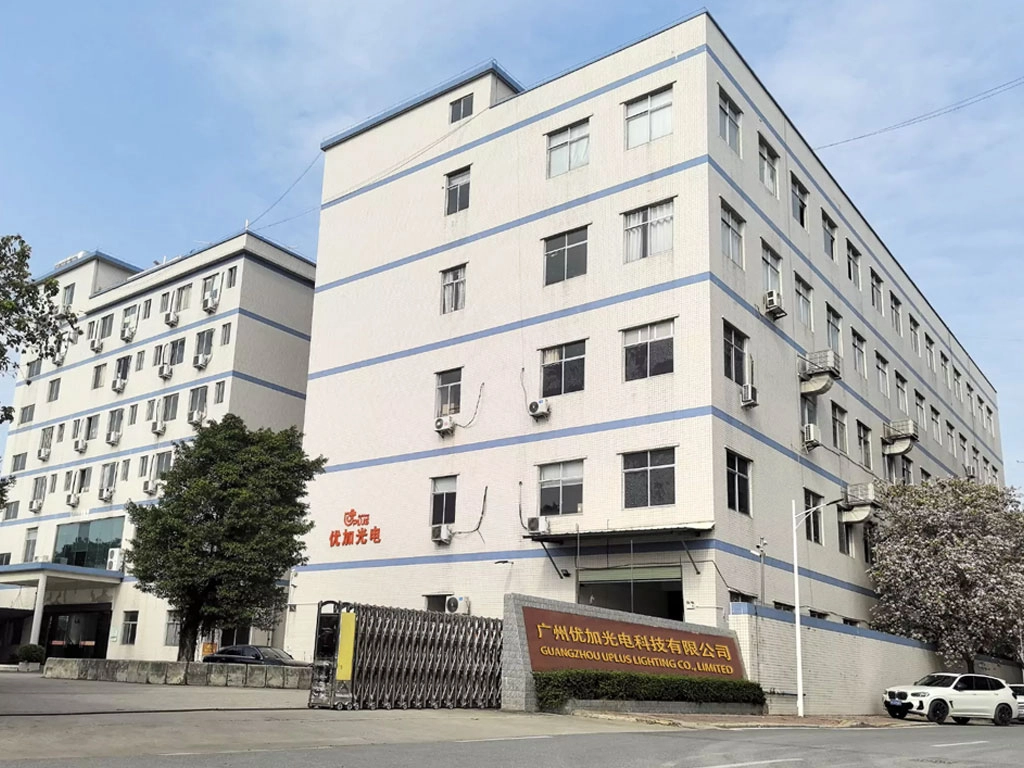
Uplus Lighting was established in 2012 in Guangzhou, China, and is a professional manufacturer specializing in high-end stage lighting products. I have evaluated products from numerous manufacturers and note that Uplus focuses on reliable, production-ready solutions suitable for theatres, studios and live events worldwide. They provide innovative and reliable lighting solutions for theaters, studios, cultural projects, concerts, and live events, with a product range that includes moving head lights, strobe lights, led battery lights, static lights, led theatre lights, led follow spot light, stage effect lights and laser lights.
Uplus's strengths include experienced product development, export-focused manufacturing, OEM capability and strict quality control. Their fixtures have been used in major concerts and televised events since 2015, and they offer customization for rental companies, distributors and project clients. For organizations seeking a partner that handles both standard product lines and customized solutions, Uplus's production team and QC approach can be compelling. If you need fixtures with specific beam shaping, gobo capability or broadcast-grade dimming/driver specs, request photometric files and flicker test reports during procurement.
Practical checklist for specification and procurement
Technical checklist I use when specifying profile stage lights
- Request full photometric reports (IES/LM-63 files) and goniometric plots.
- Ask for TM-30 and spectral power distribution graphs in addition to CRI.
- Verify LED driver dimming behavior and flicker test data if used for broadcast.
- Check lumen maintenance (L70/L80) and rated lifetime for LED modules.
- Confirm mechanical compatibility: gel frames, gobos, shutters, clamp points and focus range.
- Estimate TCO with local electricity pricing, lamp/part costs and labor rates.
Questions to ask manufacturers
- Can you provide IES files and photometric reports for the exact SKU? (required)
- What are the TM-30 Rf and Rg values at standard white points?
- Do you have flicker test reports for common camera frame rates?
- What warranty covers LED modules and drivers, and what is the expected MTBF?
- Do you support OEM labelling or customized firmware/dimming curves?
FAQs
1. Are LED profile stage lights always better than halogen?
No. LEDs excel in energy efficiency, lifetime and flexibility, but halogen/tungsten provides a continuous spectrum and familiar dimming behavior. The better technology depends on your color fidelity needs, budget, and operational priorities.
2. Do LED profiles produce the same beam quality and gobo projection as halogen ERS?
High-end LED profiles can approach or match the beam quality and gobo projection of halogen ERS when well-engineered optics and homogenizers are used. Always review manufacturer IES files and, if possible, test the fixture in-situ.
3. How much can I save on energy by switching to LED profiles?
Savings depend on fixture wattage, usage hours and local electricity costs. A common estimate is 30–70% energy reduction per fixture compared to equivalent halogen wattages. Use actual wattage and run hours to compute precise savings; DOE SSL resources are a helpful benchmark (DOE SSL).
4. Are LED profiles suitable for broadcast and high-speed camera work?
Yes, provided the fixture has a high-quality driver and documented flicker performance. Request flicker tests at your camera frame rates (including slow motion rates) before purchase.
5. What maintenance differences should I plan for?
Halogen fixtures require frequent lamp replacements, filament alignment and ballast checks. LEDs need less frequent module replacement but may require driver or thermal management service over a longer lifetime. Plan inventory and labor accordingly.
6. How should I phase upgrades from halogen to LED?
Prioritize high-use fixtures and positions with difficult access first. Consider mixed inventories to preserve specific halogen looks while gaining LED efficiency in most positions. Test LED fixtures early in your season to work out color matching and dimmer curve integration.
If you'd like, I can run a tailored cost-of-ownership model for your venue (supply wattages, run hours and local energy cost) or arrange a photometric comparison between specific halogen and LED models. For product inquiries and customized solutions, contact Uplus Lighting — they support OEM orders and custom development and have a strong track record in large concerts, opera houses and TV programs.
Contact/Consult: For direct inquiry or to view product ranges (moving head lights, strobe lights, led battery lights, static lights, led theatre lights, led follow spot light, stage effect lights, laser lights), visit Uplus Lighting or request their photometric files and warranty details to verify suitability for your project.
Customizing LED Stage Light Bars: Color, Effects, and Pixel Mapping
Price Bands and Cost Comparison for LED Profile Fixtures
Comparing Brands: Best Value Profile Stage Lights for Venues
LED Stage Light Bars for Theaters, Houses of Worship, DJs
IP-MH6200 2in1
Is the power consumption of 6 sets of 200W LED beads too high? What about energy consumption?
LED beads are highly energy-efficient. Although the total power is relatively high, it consumes less energy than traditional lighting fixtures. The heat dissipation system is also highly efficient, ensuring long-term use without problems.
MH-B150
Can the zoom range meet the needs of different scenarios?
Supports flexible zoom, allowing free switching between sharp beams and wide coverage, adapting to multiple scenarios.
IP-BF60
Can the light brightness be adjusted?
The light is soft and even. The default brightness is suitable for most fill light and illumination scenarios. It's simple to operate and requires no additional adjustment.
IP-WASH1980
Is the 6-50° zoom adjustment easy to operate? Can it accurately lock the spot size?
The zoom adjustment is smooth and precise, supporting DMX console or manual setting on a standalone unit. It can quickly lock the desired spot size, adapting to different site requirements.
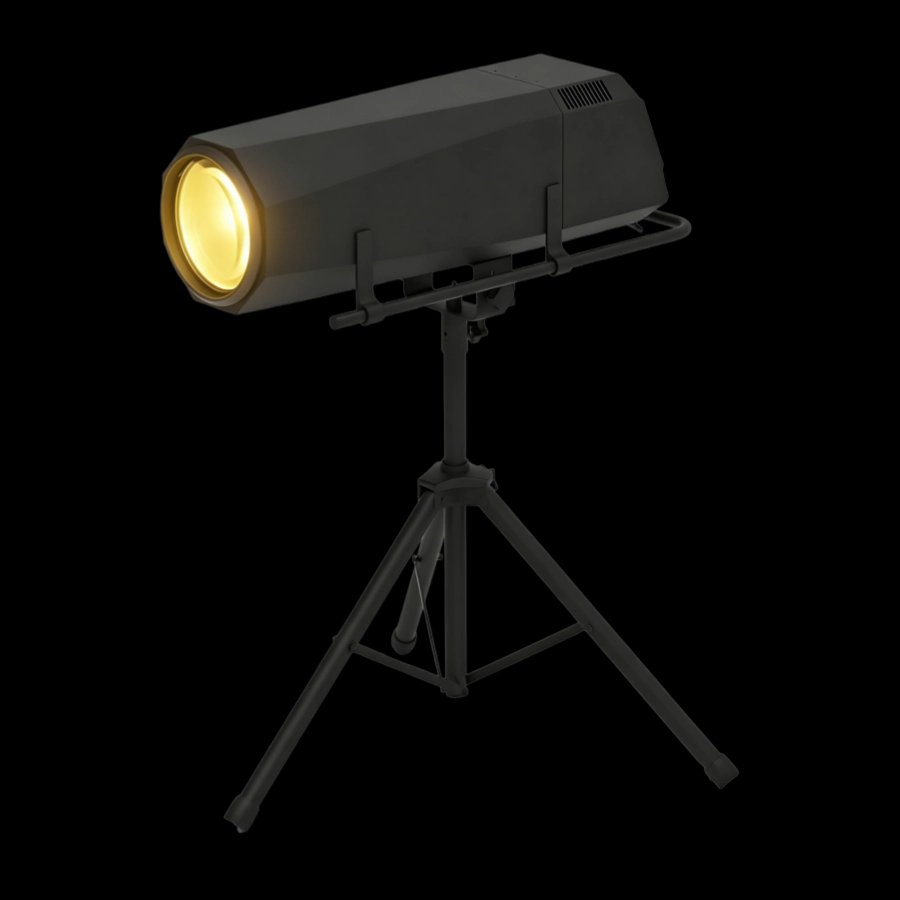
This 1200W waterproof LED follow spotlight with iris adjustment features strong light penetration, precise focusing, and smooth dimming with strobe effects.
Its rain- and dust-resistant design makes it suitable for outdoor performances, concerts, architectural lighting, and other applications. The LED light source boasts a long lifespan and stable, durable operation.
The Waterproof 1200W LED Follow Spot Light with Rotating Gobo features a rotating pattern sheet, delivering a powerful 1200W output for clear, focused beams and precise light tracking. Waterproof for outdoor use in all scenarios, the rotating pattern creates rich visual layers, making it ideal for large-scale indoor and outdoor performances, music festivals, light shows, and other events requiring focused attention and stage effects.
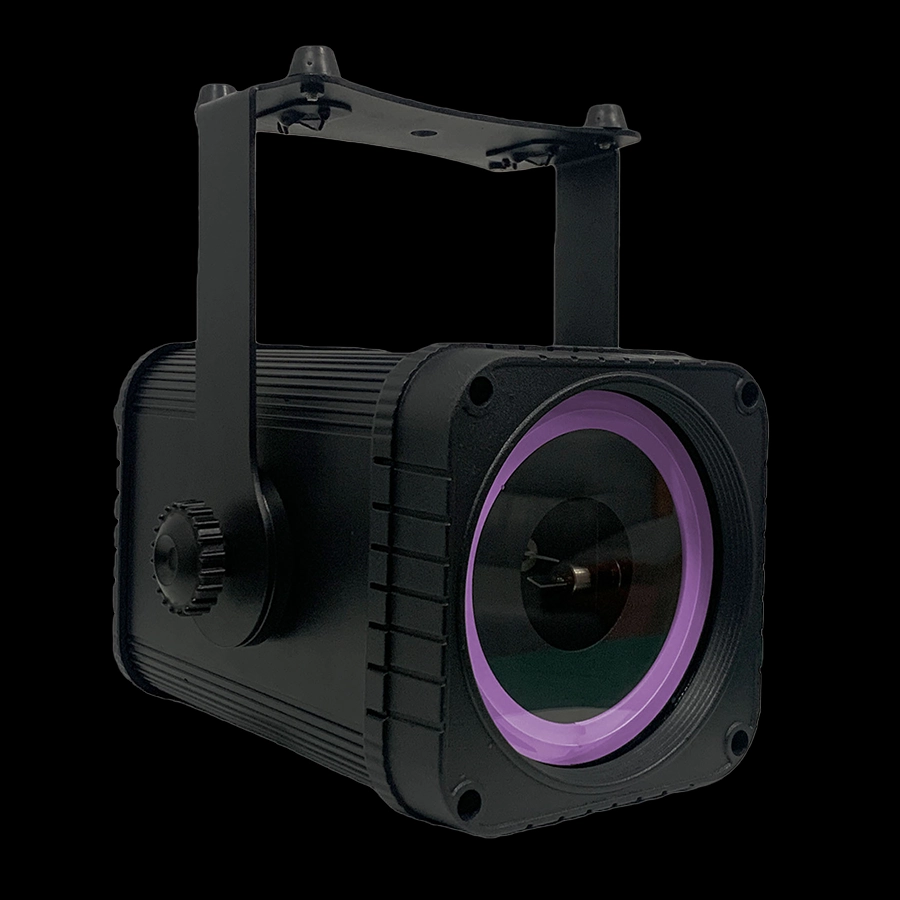
This IP65 waterproof 3W RGB animation laser battery light features an IP65 waterproof and dustproof design, making it suitable for both outdoor and indoor use. It supports rich RGB color combinations and dynamic animation effects, delivering a clear and fluid beam that can display text, patterns, and flowing light and shadow, among other visual representations.
Powered by a built-in battery, it requires no external power source, making it portable, easy to deploy, and simple to operate. Ideal for festive decorations, creating a garden atmosphere, and adding a touch of elegance to small events, it's energy-efficient, durable, and creates a truly immersive ambiance.
This IP65 waterproof 5W RGB animation laser battery light features an IP65 waterproof and dustproof design, making it suitable for both outdoor and indoor use. It supports rich RGB color combinations and dynamic animation effects, delivering a clear and fluid beam that can display text, patterns, and flowing light and shadow, among other visual representations.
Powered by a built-in battery, it requires no external power source, making it portable, easy to deploy, and simple to operate. Ideal for festive decorations, creating a garden atmosphere, and adding a touch of elegance to small events, it's energy-efficient, durable, and creates a truly immersive ambiance.
If you have any comments or good suggestions, please leave us a message, later our professional staff will contact you as soon as possible.
Lighting Innovators
Uplus Lighting is a leading integrated company specializing in R&D, design, production, and sales of stage lighting solutions.
 Scan QR Code
Facebook
Instagram
YouTube
VK