






How to Match Stage Light Moving Head Beam Angles to Stages
- Understanding Stage Geometry and Light Behavior
- Why beam angle matters more than lumen count
- Key geometric variables I always measure
- Basic beam spread formula (practical and verifiable)
- Selecting Beam Angles for Common Stage Types
- Proscenium theaters
- Concerts, festivals and arenas
- Multi-purpose studios and corporate stages
- Practical Calculations, Examples and a Reference Table
- Worked example: choosing a beam for a 10 m throw
- Reference table: Beam diameter vs distance for common beam angles
- Overlap and coverage rules I use
- Mounting, Focusing and Practical Rigging Considerations
- Truss placement and multiple heights
- Zoom and lens interchange options
- Color, beam quality and gobos
- Performance Testing, Standards and Verification
- On-site photometric checks
- Standards and recommended reading
- Documenting rigs for repeatability
- Uplus Lighting: How our products and expertise support these choices
- How Uplus product features translate to practical benefits
- FAQs
- 1. How do I calculate the beam diameter for a moving head at my venue?
- 2. What beam angle should I choose for a 12 m truss to spotlight a solo performer?
- 3. Can I use the same moving head for both gobos and wide washes?
- 4. How much overlap should I plan between adjacent beams for a smooth wash?
- 5. Are LED moving heads as reliable as discharge lamp fixtures for long throws?
- 6. How should I verify my design onsite before a show?
I write from years of hands-on experience designing lighting rigs for theaters, concerts and live events. In this article I walk through the practical steps to match stage light moving head beam angles to stages — covering how beam angles relate to throw distance, how to calculate beam diameter, how to select the right optics for a venue, and installation considerations that preserve visual quality and audience sightlines. The guidance includes worked examples, a reference table of beam spreads at common distances, and links to authoritative sources so you can verify the principles I apply.
Understanding Stage Geometry and Light Behavior
Why beam angle matters more than lumen count
When I design a lighting plan, I prioritize beam angle and beam quality (edge softness, beam uniformity, and gobos) before raw output. Lumens and lux are important, but a narrow 4° beam with high candela concentrates light into a tight spot; a 40° beam spreads the same output over a much larger area and appears much dimmer on the surface. This is a fundamental optics principle rooted in irradiance distribution and inverse-square effects, and it determines whether a moving head will provide the look and intensity you need at stage level (Stage lighting — Wikipedia).
Key geometric variables I always measure
- Stage width, depth, and proscenium opening (or performing area).
- Mounting height(s): truss height, catwalk height, grid height or balcony positions.
- Typical throw distance(s): the straight-line distance from the fixture lens to target plane (floor or performer head height).
- Desired beam footprint at the target and acceptable overlap for wash/fill.
Basic beam spread formula (practical and verifiable)
I use the simple trigonometric relationship to convert beam angle to beam diameter at a given distance. If θ is the full beam angle (in degrees) and D is the throw distance, the beam diameter (approximate) at the target plane is:
Diameter = 2 × D × tan(θ / 2)
This follows directly from basic trigonometry (Trigonometry — Wikipedia) and is the primary calculation I use to size beams and determine overlaps in layouts.
Selecting Beam Angles for Common Stage Types
Proscenium theaters
In proscenium venues I typically work with vertical masking and predictable throw distances. For tight specials on actors I favour moving head spot optics in the 4°–15° range. For frontal washes and backlight I move toward 25°–40° or even wider static fixtures. Narrow beams are excellent for highlighting soloists or gobos, while wider beams help smooth coverage across the stage.
Concerts, festivals and arenas
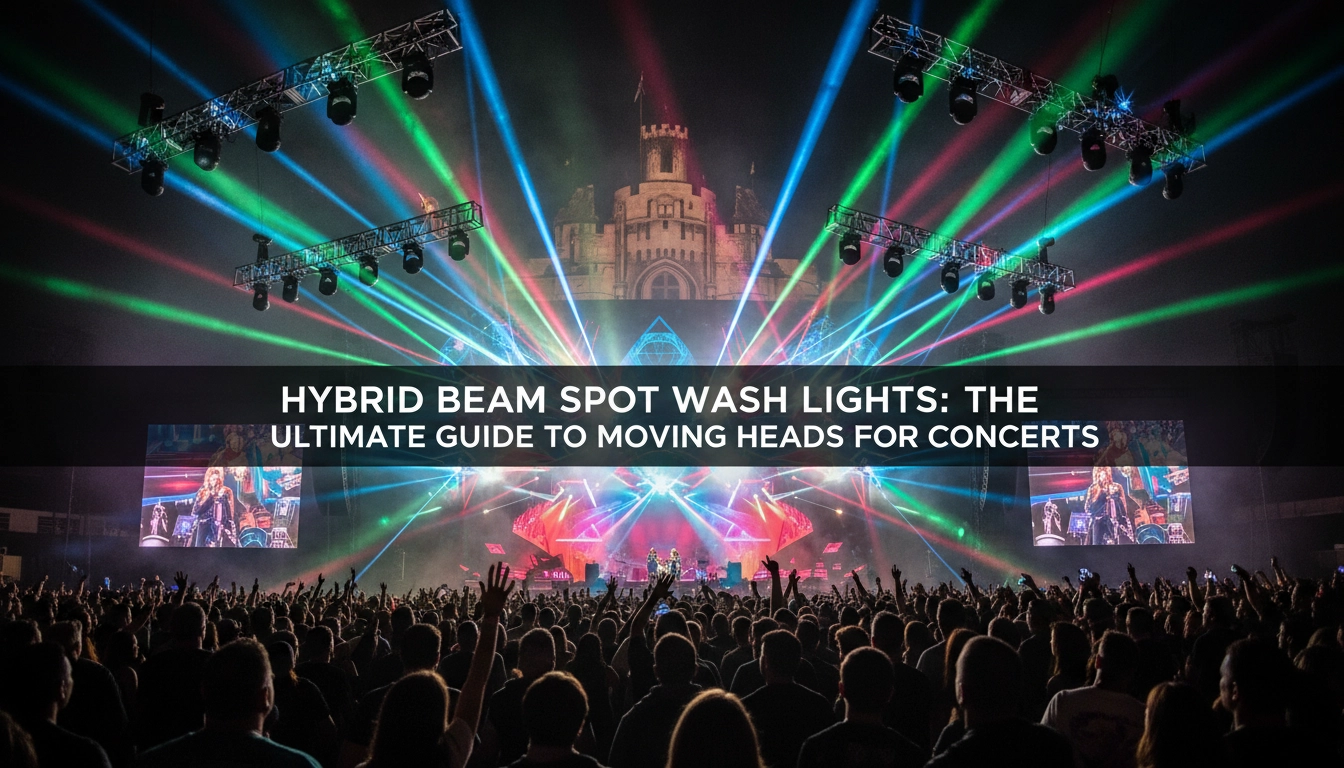
Large venues often require a mix: powerful moving head beams (2°–8°) for long throws from high trusses and mid-angle optics (12°–25°) for downstage coverage. When trusses are 15–30 m above the floor, narrow-beam fixtures maintain contrast and visibility; without them the appearance becomes washed out at distance.
Multi-purpose studios and corporate stages
For flexible spaces I recommend moving head fixtures with interchangeable lenses or zoom ranges (e.g., 4°–50°). That lets you adapt from spotlighting a presenter to filling a shallow product stage without refocusing the rig. I also account for camera requirements: camera sensors prefer softer edges and even distribution, so slightly wider beams or diffused optics are often selected for broadcast settings.
Practical Calculations, Examples and a Reference Table
Worked example: choosing a beam for a 10 m throw
Suppose you have a truss at 10 m above the stage and you want a beam footprint about 1.4 m diameter on the floor to highlight a singer. Rearranging the formula:
θ = 2 × arctan( (Diameter / 2) / D )
Plugging in Diameter=1.4 m and D=10 m gives:
θ ≈ 2 × arctan(0.7 / 10) ≈ 2 × arctan(0.07) ≈ 2 × 4.003° ≈ 8.0°
So I would choose a moving head with an 8° beam or a zoom fixture that can tighten to ~8° (common in many professional moving head beams).
Reference table: Beam diameter vs distance for common beam angles
Below I provide a quick reference I use on site. Numbers are calculated using Diameter = 2 × D × tan(θ / 2).
| Beam Angle (full) | Beam Diameter at 5 m | Beam Diameter at 10 m | Beam Diameter at 15 m |
|---|---|---|---|
| 4° | 0.35 m | 0.70 m | 1.05 m |
| 8° | 0.70 m | 1.40 m | 2.10 m |
| 15° | 1.32 m | 2.63 m | 3.95 m |
| 25° | 2.22 m | 4.43 m | 6.65 m |
| 40° | 3.64 m | 7.28 m | 10.92 m |
These values are approximate and assume unobstructed, perpendicular throws. When fixtures are angled off-axis or when you need even field lighting, plan for higher overlap.
Overlap and coverage rules I use
- For wash coverage I aim for 10%–30% overlap between adjacent beams depending on beam edge softness.
- For specials or gobos I allow minimal overlap (0%–5%) to preserve contrast and sharpness.
- When using narrow moving head beams at long throw distances, include a 10% brightness margin to compensate for atmospheric loss and lens dirt.
Mounting, Focusing and Practical Rigging Considerations
Truss placement and multiple heights
I recommend layout mockups that plot fixture positions in elevation and plan view. If you rely on a single high truss, expect to need narrower beams; if you have a front-of-house and low side booms, combine wider and narrower optics to create layered depth.
Zoom and lens interchange options
Many professional moving head fixtures have motorized zoom heads (e.g., 6°–50°) or interchangeable lens tubes. If you operate a rental company or a multi-use venue I advise investing in zoom moving heads or a small set of interchangeable lens tubes to reduce the number of fixture types required while keeping optical flexibility.
Color, beam quality and gobos
Beam angle selection interacts with color saturation and gobo definition. Narrow beams retain higher color saturation and sharper gobo projection; wider beams mix colors and soften gobo edges. When specifying moving head profiles for theatrical work, I reference the manufacturer's MTF-style data and the gobo projection examples to evaluate expected sharpness on stage.
Performance Testing, Standards and Verification
On-site photometric checks
I always verify my calculations with on-site lux measurements. Use a calibrated lux meter at the performer plane and measure at intended zoom settings. Compare against your lighting plot target lux values for the scene. This real-world verification prevents surprises once the show lights up.
Standards and recommended reading
For general best practices in stage lighting I refer to standard resources and guides such as the technical sections of lighting manufacturers and introductory material on stage lighting theory (Stage lighting — Wikipedia) and optical calculation principles (Trigonometry — Wikipedia).
Documenting rigs for repeatability
To ensure consistent results I document fixture type, lens/zoom setting, pan/tilt values, beam focus and lamp/LED settings in the rig sheet. This makes swap-outs and maintenance straightforward and preserves the intended beam shapes for repeat productions.
Uplus Lighting: How our products and expertise support these choices
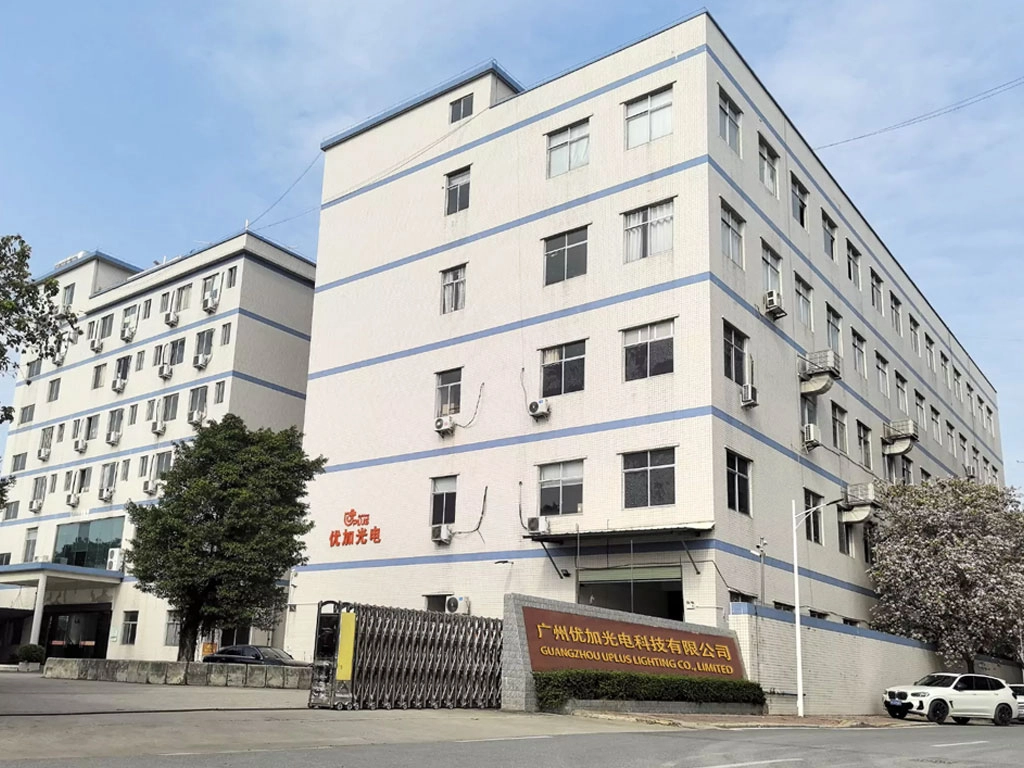
Uplus Lighting was established in 2012 in Guangzhou, China, and is a professional manufacturer specializing in high-end stage lighting products. I partner with manufacturers like Uplus when I need fixtures that combine reliable mechanics, consistent beam quality, and flexible optics. Uplus provides innovative and reliable lighting solutions for theaters, studios, cultural projects, concerts, and live events worldwide. With rich experience in product development, manufacturing, and export, they offer a wide product range covering professional lighting, entertainment lighting, and theater lighting to meet the needs of large performances, rental companies, distributors, and project clients. Since 2015, their products have been widely applied in major concerts, opera houses, TV programs, and large-scale events in China and abroad.
Their moving head lights, strobe lights, LED battery lights, static lights, LED theatre lights, LED follow spot light, stage effect lights, and laser lights are engineered for stable performance. Uplus supports OEM orders and customized product development. A skilled production team and strict quality control help ensure consistent quality and professional service trusted by global partners. In my experience working on multi-venue projects, reliable supplier support and repeatable photometrics from the manufacturer shorten programming time and reduce onsite adjustments.
How Uplus product features translate to practical benefits
- Zoom ranges and interchangeable optics reduce the number of fixture types needed on a tour.
- High-quality lenses and precise motorized focus preserve gobo definition at distance.
- Consistent color mixing and stable LED engines guarantee predictable lux output across a run of shows.
If you want specific suggestions, I can provide recommended Uplus models for your stage dimensions and performance goals, including optimal beam angles and lens configurations.
FAQs
1. How do I calculate the beam diameter for a moving head at my venue?
Use Diameter = 2 × D × tan(θ / 2) where D is throw distance and θ is the fixture's full beam angle. This calculation gives you the approximate footprint on the target plane.
2. What beam angle should I choose for a 12 m truss to spotlight a solo performer?
For a 12 m throw and a desired footprint around 1.5 m, solve θ ≈ 2 × arctan((0.75)/12) ≈ 7.15°. So an 8° moving head or a zoom fixture tightened to ~8° is appropriate.
3. Can I use the same moving head for both gobos and wide washes?
Yes, if the moving head has a suitable zoom range (e.g., 6°–50°) and a high-quality lens system. Interchangeable tubes are another solution. However, for best gobo definition and maximum brightness at long throw you'll often prefer a dedicated narrow-beam profile.
4. How much overlap should I plan between adjacent beams for a smooth wash?
I typically design 10%–30% overlap depending on beam edge softness. Softer beams need less overlap; hard-edged beams need more to avoid visible seams.
5. Are LED moving heads as reliable as discharge lamp fixtures for long throws?
Modern LED moving heads can match or exceed many discharge lamp fixtures in terms of stability and color consistency, but lumen maintenance, lens quality, and thermal management are key. Always check the photometric data and request measurements at the required zoom/throw from the manufacturer.
6. How should I verify my design onsite before a show?
Perform lux readings at performer plane for each important cue, validate beam shapes visually and photographically from audience sightlines, and adjust focus/zoom so that gobos and color transitions behave as intended.
If you want tailored recommendations for your venue, rig plan, or product selection, contact our technical team or view the product range. I can help map fixture types and beam angles to your stage geometry and produce a photometrically verified lighting plot.
Contact/See Products: For product details, custom development or OEM requests, reach out to Uplus Lighting via their official channels or request a lighting consultation to get recommended moving head lights, beam angles, and rigging plans tailored to your project.
25 Best Moving Head Lights for Concerts: The 2026 Ultimate Pro-Grade Comparison
Profile Stage Lights Maintenance: Extend Lifespan & Reduce Costs
How to Choose Profile Stage Lights: Beam Angle, Lenses, Power
Top 10 Laser Light Moving Head Fixtures for Touring Shows
Theater
Is the lighting control system complex to operate?
Our intelligent lighting control system features a user-friendly interface that is simple and easy to operate. We provide detailed operation training to ensure your team can easily master the system and get started quickly.
IP-BF60
What environments can IP65 protection handle?
It's dustproof and waterproof, resisting rain, dew, and splashes, making it safe for both indoor and outdoor use.
IP-WASH6125
How to ensure consistent lighting effects when multiple lights are running simultaneously?
Supports DMX512 synchronous control and master-slave mode, allowing for unified parameter settings and ensuring complete synchronization of lighting effects and speed across multiple lights.
About Company
Our service?
We have a professional team that can provide and customize products for you.
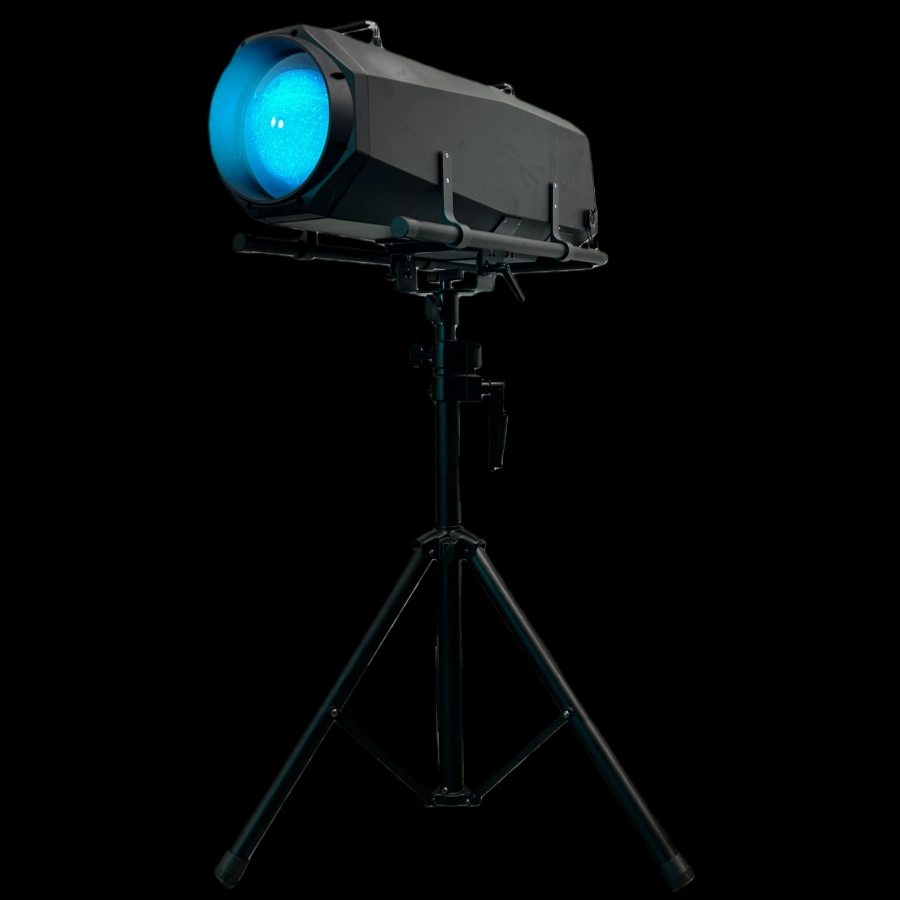
This 1200W waterproof LED follow spotlight with iris adjustment features strong light penetration, precise focusing, and smooth dimming with strobe effects.
Its rain- and dust-resistant design makes it suitable for outdoor performances, concerts, architectural lighting, and other applications. The LED light source boasts a long lifespan and stable, durable operation.
The Waterproof 1200W LED Follow Spot Light with Rotating Gobo features a rotating pattern sheet, delivering a powerful 1200W output for clear, focused beams and precise light tracking. Waterproof for outdoor use in all scenarios, the rotating pattern creates rich visual layers, making it ideal for large-scale indoor and outdoor performances, music festivals, light shows, and other events requiring focused attention and stage effects.
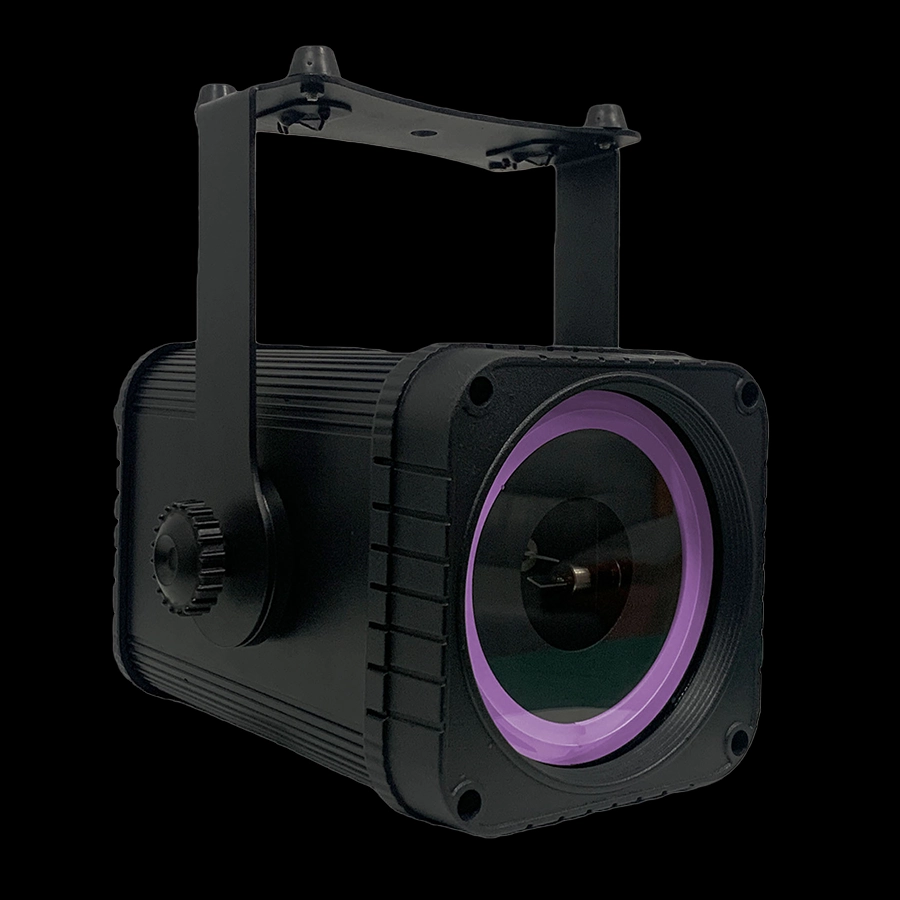
This IP65 waterproof 3W RGB animation laser battery light features an IP65 waterproof and dustproof design, making it suitable for both outdoor and indoor use. It supports rich RGB color combinations and dynamic animation effects, delivering a clear and fluid beam that can display text, patterns, and flowing light and shadow, among other visual representations.
Powered by a built-in battery, it requires no external power source, making it portable, easy to deploy, and simple to operate. Ideal for festive decorations, creating a garden atmosphere, and adding a touch of elegance to small events, it's energy-efficient, durable, and creates a truly immersive ambiance.
This IP65 waterproof 5W RGB animation laser battery light features an IP65 waterproof and dustproof design, making it suitable for both outdoor and indoor use. It supports rich RGB color combinations and dynamic animation effects, delivering a clear and fluid beam that can display text, patterns, and flowing light and shadow, among other visual representations.
Powered by a built-in battery, it requires no external power source, making it portable, easy to deploy, and simple to operate. Ideal for festive decorations, creating a garden atmosphere, and adding a touch of elegance to small events, it's energy-efficient, durable, and creates a truly immersive ambiance.
If you have any comments or good suggestions, please leave us a message, later our professional staff will contact you as soon as possible.
Lighting Innovators
Uplus Lighting is a leading integrated company specializing in R&D, design, production, and sales of stage lighting solutions.
 Scan QR Code
Facebook
Instagram
YouTube
VK